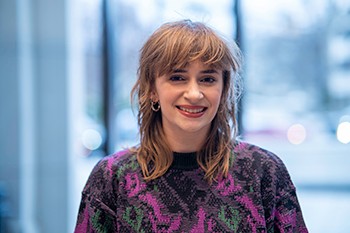
Speaking the Language of Love: Alex Thurtle '26 MA Brings Words and Feelings to Life
For their Theatre capstone project, Thurtle created an archive of audience responses to prompts inspired by Julia Cho’s The Language Archive and authored a pronunciation guide for an invented language within the play.
When audience members filtered out of the John and Joan Mullen Center for the Performing Arts after seeing The Language Archive, they didn’t just carry away a Playbill—they left their voices behind.
In a small recording booth set up in the theatre lobby, they were invited to respond to a simple, yet profound, question inspired by Julie Cho’s play: “How do you say, ‘I love you?’”
For Alex Thurtle ’26 MA, a Villanova University master’s student in Theatre, collecting those voices became both art and research.
“From the beginning of this project, I knew that I wanted to find a way for our audiences to connect with the subject matter,” Thurtle said. “I wanted to make sure that I got representation from a variety of ages and languages, and I really wanted to reach our Villanova community.”
Thurtle said more than 40 people participated in the project over the play’s two-week run from September 25 through October 5, 2025.
“The response was beautiful,” they said. “We got such incredible answers. Parents sang songs to their children, friends shared inside jokes, I think someone spoke Klingon. One person even said their way of saying, ‘I love you,’ is just showing up. It was a beautiful way to engage with the community.”
The Language Archive centers on the character George, a linguist documenting dying languages while struggling to express love in his own life. For Thurtle, the show’s exploration of communication and connection was a perfect research opportunity.
“I’ve always viewed language through a poetic lens,” Thurtle said. “Julia Cho’s writing is witty, poignant and deeply human. The play touches on colonialism, grief, marriage and identity, all through the way people do or don’t communicate.”
As part of their dramaturgical work, Thurtle explored the linguistic texture of the play, in which the characters speak Esperanto, a language invented L.L. Zamenhoff, and Ellowan, another made-up language for which Thurtle created a pronunciation guide. Working closely with the cast and a dialect coach, they blended influences from Slavic and Estonian sounds to make the fictional language sound authentic.
“The language is meant to mimic the flowing of water,” Thurtle explained. “We wanted it to sound musical and alive, even though it doesn’t exist.”
The project’s reach extended further when Thurtle presented it at the Society for Ethics Across the Curriculum conference held at Villanova, a chance to explore the work’s interdisciplinarity. Thurtle presented alongside James Waters, PhD, a Catherine of Siena Teaching Scholar in the Ethics program.
“It was special to present my work to ethics scholars and philosophers because I can ask, ‘How does theatre and consuming art enhance our learning as scholars?’ Theater is an interdisciplinary force. It’s where we can learn empathy, ethics and how to listen,” Thurtle said.
“To have an art object that was created out of the response to a show is so unique, and you don't usually get to do that,” they said. “I feel so lucky and privileged to get to facilitate that.”
About Villanova University’s College of Liberal Arts and Sciences: Since its founding in 1842, Villanova University’s College of Liberal Arts and Sciences has been the heart of the Villanova learning experience, offering foundational courses for undergraduate students in every college of the University. Serving more than 4,500 undergraduate and graduate students, the College is committed to fortifying them with intellectual rigor, multidisciplinary knowledge, moral courage and a global perspective. The College has more than 40 academic departments and programs across the humanities, social sciences, and natural and physical sciences.
SCHEDULE YOUR CAMPUS TOUR
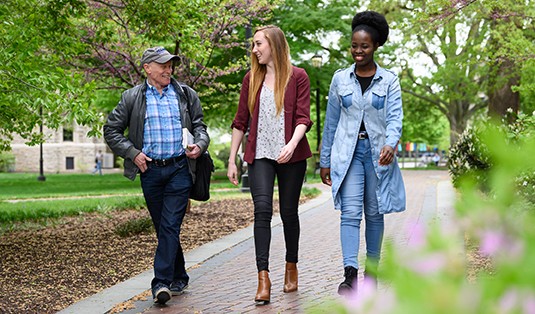
The CLAS Office of Graduate Studies offers personal tours of the beautiful Villanova campus. All tours begin in the Graduate Studies Office, located in Vasey Hall.
Schedule your tour!