Nostalgia or Infringement? Inside Penn State’s Battle to Protect Retro Logos
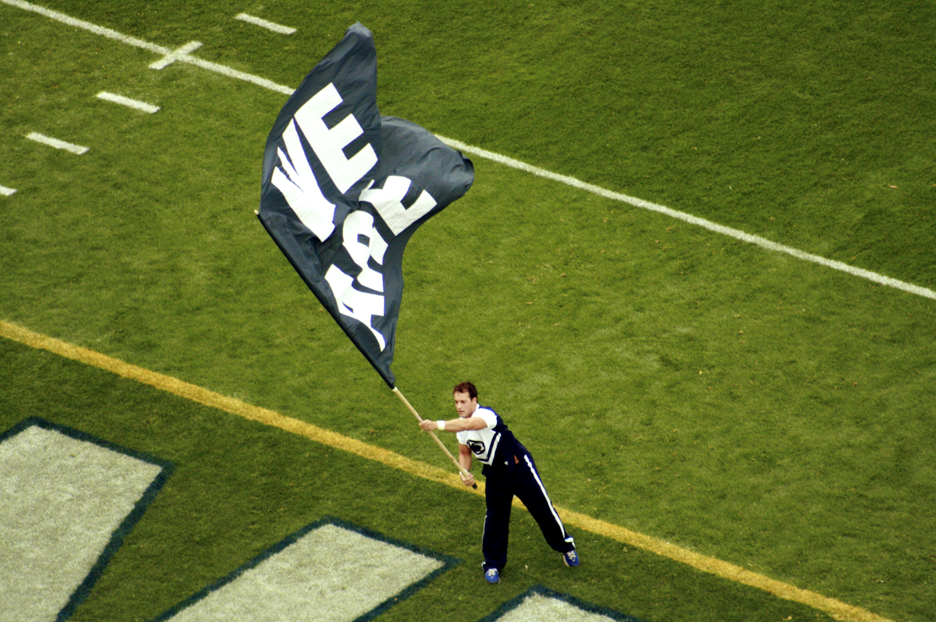
Photo Source: Caitlin Regan, We Are Penn State, Flickr (Aug. 30, 2008) (CC BY 2.0).
By: Molly Moore* Posted: 10/31/2025
Fans experience “Penn State” differently: alumni may think of the Joe Paterno era, while current students may picture the White Out game and modernized logos.[1] At tailgates in State College, Pennsylvania, the mix of jerseys, hats, and memorabilia from decades past reflect a range of personal memories and connections to the University.[2] Penn State University was founded in 1855 and currently has over 800,000 alumni, with a football program valued at $924 million.[3] This passionate fanbase also creates a lucrative market for Penn State-branded merchandise, making the University’s trademarks both financially and culturally significant.[4] However, because alumni often associate older logos with the emotions they felt while attending Penn State, there is a strong market for nostalgic merchandise.[5] By siding with Penn State in its suit against the nostalgic memorabilia company Vintage Brand, the court reinforced that trademark law prioritizes institutional control, brand revenue, and licensing programs over fan-driven nostalgic merchandising, highlighting the tension between intellectual property rights, sports culture, and the commercial exploitation of historic logos.[6]
What is Trademark Law?
A trademark is "any word, name, symbol, or device" that is used to identify and distinguish the products sold by one person from all other products in the marketplace.[7] Trademarks are used to ensure the consumer can identify products associated with the mark and to indicate the quality of a product based on that mark.[8] To receive protection nationally, brands register their trademark with the United States Patent and Trademark Office.[9]
Trademark infringement is established when a plaintiff demonstrates they own a valid mark and the defendant has used the mark in a way that creates a likelihood of confusion in the marketplace.[10] The Third Circuit held that likelihood of confusion is determined by a variety of factors, including the degree of similarity between the two marks, the strength of the owner’s mark, the price of the goods, the amount of time the defendant has been using the alleged infringing mark, the defendant’s intent for using the mark, evidence that consumers were actually confused, and whether the two marks were sold in the same marketplace.[11] If trademark infringement is established, the plaintiff may receive damages, injunctions, and disgorgement of profits.[12] Sports apparel is particularly susceptible to confusion because fans often assume that merchandise bearing a school’s logo is officially licensed.[13]
Further, trademark protection does not expand to functional features of a product.[14] A design feature that is ornamental, enhancing the product’s appearance rather than identifying the source, may fall outside the scope of trademark protection.[15] This ornamentality and source-identification distinction was central to Penn State’s claims against Vintage Brand.[16]
Penn State’s Trademark Strategy
Penn State has built a strong portfolio of trademarks.[17] This includes the registration for the words “Penn State,” “Nittany Lion,” multiple versions of the Lion, and the Penn State seal.[18] The marks extend to a wide range of goods including sweatshirts, drinking glasses, hats, and flags.[19] Some of these trademarks were granted after Penn State demonstrated they had “acquired distinctiveness,” meaning that geographic terms like “Pennsylvania” were synonymous with the University in the mind of consumers.[20] By demonstrating acquired distinctiveness, Penn State showed that its marks were widely recognized as indicating sponsorship or affiliation with the University, rather than merely serving a decorative purpose.[21]
Penn State has a licensing program, managed by an exclusive licensing agent responsible for negotiating agreements with merchandisers.[22] This program ensures quality control, generates significant revenue, and allows Penn State to take legal action against unauthorized sellers.[23] Through this licensing structure, Penn State safeguards both the financial and symbolic value of its trademarks, ensuring that any merchandise bearing its marks maintains quality standards and association with the University brand.[24]
While Penn State aggressively protects its marks, the University’s official merchandise offers a limited selection of throwback items, many of which are priced at a premium.[25] Enter Vintage Brand: an online retailer that sells apparel and merchandise featuring images from the public domain depicting vintage sports memorabilia, which is incorporated into its product design.[26] This market gap created space for Vintage Brand to serve nostalgic fans seeking affordable designs that Penn State and their official licensing partners do not widely provide.[27]
Penn. State Univ. v. Vintage Brand
In 2021, Penn State sued Vintage Brand for willful infringement of its trademarks because Vintage Brand was selling Penn State historic logos on items without a license, potentially creating consumer confusion about official sponsorship.[28] Vintage Brand raised the defense that the logos were used for ornamental purposes to show pride for the school, not to identify the source of the merchandise.[29] The argument emphasized that fans were motivated by nostalgia and sentimentality rather than a belief that the merchandise was officially licensed.[30]
The court rejected this argument, finding that there were other ways that Vintage Brand could have sold non-infringing apparel to the Penn State fan base without using the marks.[31] Further the court stated that Penn State’s marks were widely recognized indicators of source rather than mere decoration.[32] Applying the Lapp factors, the court emphasized the strength of Penn State’s marks, the similarity of Vintage Brand’s use, and the overlap in consumers.[33] This decision illustrates how ornamental use in arguments can fail when the mark has been long tied to an official licensing program.[34]
The jury ruled in favor of Penn State because Vintage Brand did infringe on their trademarks, awarding Penn State $28,000 in compensatory damages based on the revenue from Vintage Brand’s sale of 1,269 products with Penn State marks.[35] Although Penn State’s monetary award was minor compared to its billion-dollar football valuation, the symbolic victory was significant.[36] This case serves as a warning for retailers that even “retro” logos may remain legally protected because of the nature of trademark law and cannot be used without a license.[37]
Balancing Trademark Protection and Connection to Brand
While this decision reaffirms universities’ power to protect their trademarks, it also raises questions about whether such strict control benefits the Penn State community.[38] By limiting the availability of nostalgic designs, Penn State may alienate fans and alumni who wish to celebrate the history and identity they associate with the older logos.[39] Many alumni may resonate more with the vintage marks because they were the logos from their own time at Penn State, linking the imagery with their personal memories and sense of belonging.[40] For these supporters, vintage merchandise represents connection, not competition, and overly rigid enforcement can risk turning loyalty into frustration, weakening the emotional bond that makes a university brand valuable in the first place.[41] Because Penn State lacks a robust catalog of throwback memorabilia, they should either encourage their official licensees to expand into this market or ease up on trademark enforcement from third-parties trying to serve consumers in this market.[42] As Penn State’s brand framework emphasizes community and the spirit of “We Are Penn State,” the University and others like it must balance trademark protection with preserving goodwill among their most dedicated supporters.[43]
*Staff Writer, Jeffrey S. Moorad Sports Law Journal, J.D. Candidate, May 2027, Villanova University Charles Widger School of Law.
[1] See Paterno’s Impact Spanned Generations, Penn State Univ. (Oct. 17, 2019), https://www.psu.edu/news/athletics/story/paternos-impact-spanned-generations (outlining historic coaching career of longtime coach, Joe Paterno); see also Douglas Santo, Could Penn State’s White Out Game Against Oregon Break the Attendance Record? Here Are the Largest Beaver Stadium Crowds, Yahoo! Sports (Sep. 22, 2025, at 22:58 UTC), https://sports.yahoo.com/article/could-penn-states-white-game-225802949.html (explaining recent tradition of White Out game); Penn State Launching New Nittany Lion Logos, Signature Marks, Penn State Univ. (Oct. 2, 2024), https://www.psu.edu/news/campus-life/story/penn-state-launching-new-nittany-lion-mascot-logos-signature-marks (highlighting newest marks featuring Nittany Lion mascot that will be featured on new merchandise).
[2] See Santo, supra note 1 (stating largest attendance at Penn State game was 111,030 people); see also Penn State Nittany Lions School History, Sports Reference, https://www.sports-reference.com/cfb/schools/penn-state/index.html (last visited Oct. 12, 2025) (showing history of Penn State football program, beginning in 1871 and has winning national championships in 1911, 1912, 1982, and 1986); James Parks, New Study Reveals Biggest Fan Bases in College Football, Sports Illustrated (Aug. 17, 2022), https://www.si.com/fannation/college/cfb-hq/ncaa-football/college-football-rankings-teams-fan-bases-ohio-state-texas-alabama-georgia-notre-dame (highlighting how Penn State has roughly 6.36 million fans and is one of most followed football programs in country).
[3] See Facts and Rankings, Penn State Univ., https://www.psu.edu/about/facts-and-rankings (last visited Oct. 12, 2025) (highlighting history of Penn State University); see also Michael Ozanian, What the Top 75 College Sports Programs Are Worth, CNBC (Dec. 19, 2024), https://www.cnbc.com/2024/12/19/college-sports-programs-valuations.html (listing Penn State as eleventh highest valued program, with $202 million in revenue in 2024).
[4] See Darian Somers, I Went Through Penn State’s 2023-24 Athletics Financial Report So You Don’t Have To, Stuff Somers Says (Jan. 22, 2025), https://stuffsomerssays.com/the-blog/2025/01/22/i-went-through-penn-states-2023-24-athletics-financial-report-so-you-dont-have-to/?srsltid=AfmBOopAlBniCYwnT4arUyMPaGQ1OGJwo6g96_h3FuWGJJ1SJ2j-0a-f&utm (stating that from 2023 to 2024, licensing brought in $15.2 million in revenue).
[5] See Geoff Rushton, ‘Love Ya Lions!’ Returns With Line of Merchandise Featuring Vintage Penn State Mark, StateCollege.com (Feb. 14, 2025), https://www.statecollege.com/articles/psu-news/love-ya-lions-returns-with-line-of-merchandise-featuring-vintage-penn-state-mark/ (stating fan requests resulted in vintage “Love Ya Lions” mark from 1970s back in circulation on merchandise).
[6] See generally Penn. State Univ. v. Vintage Brand, LLC, 715 F. Supp. 3d 602, 660–68 (M.D. Pa. 2024) (holding Vintage Brand willfully infringed upon Penn State’s marks using vintage logos in merchandise). For further discussion of the tension in trademark law with mark owner rights and vintage logos, see infra notes 28–43.
[7] See 15 U.S.C. § 1127 (2018) (“[T]o identify and distinguish his or her goods, including a unique product, from those manufactured or sold by others and to indicate the source of the goods, even if that source is unknown”).
[8] See Timothy M. Barber, High Court Takes Right Turn in TrafFix, But Stops Short of the Finish Line: An Economic Critique of Trade Dress Protection for Product Configuration, 7 Marq. Intell. Prop. L. Rev. 259, 262 (2003) (highlighting purpose for trademark law is to protect consumers).
[9] See What Is a Trademark?, U.S. Pat. & Trademark Off., https://www.uspto.gov/trademarks/basics/what-trademark (last visited Oct. 12, 2025) (explaining to have strong national rights with no expiration unless abandoned, registration is required).
[10] See 15 U.S.C. § 1114 (1) (2018) (explaining requirements to prove trademark infringement).
[11] Interpace Corp. v. Lapp, Inc., 721 F.2d 460, 463 (3d Cir. 1983) (outlining factors used by Third Circuit to establish likelihood of confusion to prove trademark infringement).
[12] See 15 U.S.C. § 1117 (2018) (explaining potential remedies associated with trademark infringement).
[13] See Tim Feathers & Marshall Kelner, Penn State Victory Maintains Uneasy Status Quo in Sports Merchandising Industry, Stinson (May 7, 2025), https://www.stinson.com/newsroom-publications-penn-state-victory-maintains-uneasy-status-quo-in-sports-merchandising-industry (explaining Penn State’s aggressively protects its trademark because it believes public associates logo with official licensed products).
[14] See Qualitex Co. v. Jacobson Prods. Co., 514 U.S. 159, 165 (1995) (holding functional marks cannot be trademarked).
[15] See 1 McCarthy on Trademarks and Unfair Competition § 7:24 (5th ed. 2024) (“[A] design is pleasing to the eye and serves a decorative purpose does not mean that the design cannot also serve a trademark purpose.”); see also TMEP § 1202.03 (May 2025) (explaining how design feature fails as trademark if it is “merely ornamental” and consumers are unlikely to see it as identifying source).
[16] See generally Penn. State Univ. v. Vintage Brand, LLC, 715 F. Supp. 3d 602, 660–68 (M.D. Pa. 2024) (outlining Penn State’s argument against Vintage Brand for trademark infringement).
[17] See University Mark and Shield, Brand Book, Penn State Univ., https://brand.psu.edu/visual-identity-standards/university-mark-and-shield (last visited Oct. 12, 2025) (highlighting scope of Penn State’s trademark portfolio).
[18] See Penn. State Univ., 715 F. Supp. 3d at 617 n.41 (stating all trademarks owned by Penn State, including “PENN STATE”, Pozniak Lion, “NITTANY LION”, and image of lion).
[19] See id. (explaining how first marks were registered in 1983 and more recent marks in 2019 extended protection of mark to even more types of goods).
[20] See id. (highlighting Penn State was able to trademark “Pennsylvania” in 2019 by claiming it acquired secondary meaning with “THE PENNSYLVANIA STATE UNIVERSITY” mark); see also Wal-Mart Stores, Inc. v. Samara Bros., Inc., 529 U.S. 205, 209 (2000) (explaining requirement of secondary meaning for acquired distinction trademarks).
[21] See Penn. State Univ., 715 F. Supp. 3d at 641 (explaining how court could not rule that as matter of law marks were not ornamental).
[22] See id. at 614 (outlining Penn State’s process for licensing its marks to merchandisers).
[23] See id. at 615 (“[The Collegiate Licensing Company] facilitates agreements between [Penn State] and potential licensees, helps review and evaluate prospective licensees’ merchandise to determine quality, and helps enforce Penn State's rights against counterfeiters.”)
[24] See Tiffany D. Gehrek, Trademark Lawsuit Could Disrupt a Big Business for Higher Ed, Univ. Bus. (Aug. 20, 2024), https://universitybusiness.com/trademark-lawsuit-could-disrupt-a-big-business-for-higher-ed/ (noting potential implications of ruling prior to jury verdict, decision in favor of defendant could open door to widespread litigation, while ruling for Penn State would continue to allow universities to control and restrict use of their marks).
[25] See generally Penn State Athletics Online Store, https://shop.gopsusports.com/penn-state-nittany-lions/vintage-clothing/t-24336077+c-12737647+z-990-1745699160 (last visited Oct. 12, 2025) (showing limited selection of “vintage” merchandise).
[26] See Adam G. Kelly & Maria R. Sinatra, Is Vintage Brand’s Use of Penn State-Related Images Likely to Confuse Consumers as to Their Source? That Is the Central Question at Trial, Venable LLP (Nov. 19, 2024), https://www.venable.com/insights/publications/2024/11/is-vintage-brands-use-of-penn-state-related-images (describing business practices of Vintage Brand).
[27] See Penn. State Univ. v. Vintage Brand, LLC, 715 F. Supp. 3d 602, 615–17 (explaining how from 2018 to 2021, Vintage Brand scanned images from sports memorabilia, selling it on merchandise).
[28] See Muzamil Huq & Holly M. Petersen, Penn State Secures Trademark Victory in Dispute over Vintage Merch, Morrison Foerster (Dec. 9, 2024), https://www.mofo.com/resources/insights/241209-penn-state-secures-trademark-victory-in-dispute-over-vintage-merch (highlighting basis for lawsuit is Vintage Brand’s process to create their memorabilia).
[29] See id. (describing defense raised by Vintage Brand that the mark was used for ornamental purposes, which would invalidate the mark because it is functional).
[30] See Penn. State Univ., 715 F. Supp. 3d at 640–42 (noting that Vintage Brand argued Penn State’s marks were merely ornamental because they did not indicate source of tangible goods sold by Vintage Brand, while Penn State contended marks served source-identifying function as secondary source, indicating sponsorship or authorization).
[31] See id. at 647–48 (describing how Vintage Brand could have used historic drawings, creative language, or non-protected colors to appeal to fan base to purchase their merchandise without using registered marks).
[32] See id. at 648 (explaining negative practical implications of ruling for Vintage Brand by finding university marks functional would result in no university being able to protect their goods because consumers wear those marks to express support for institution).
[33] See id. at 648–50 (finding that Vintage Brand argued there was no likelihood of confusion because it did not intend to deceive consumers, used disclaimers, and marks were not identical to Penn State’s, but court found genuine issue of material fact as to similarity, mark strength, consumer sophistication, actual confusion, and relationship of goods that must be resolved by a jury, defeating motion for summary judgment).
[34] See Trevor T. Graves, University Wins Jury Verdict over Retailer for Trademark Infringement, Stiles & Harbison (Jan. 8, 2025), https://www.stites.com/resources/client-alerts/university-wins-jury-verdict-over-online-retailer-for-trademark-infringement/ (highlighting jury verdict and implications it has for trademarks owners).
[35] See Huq & Petersen, supra note 28 (stating jury findings, damages award, and criteria used to justify that Vintage Brand was liable for willfully infringing Penn State’s trademarks when selling merchandise with retro logos).
[36] See Maryclaire Dale, Penn State Wins Trademark Case over Retailer’s Use of Vintage Logos, Images, Associated Press (Nov. 21, 2024), https://apnews.com/article/college-sports-vintage-trademarks-retail-penn-state-53cee3aa4a5377fc7db370cc6cb3cc18 (stating consequences of ruling, enabling universities to continue protecting their trademarks and respecting of official licensees’ marks compliance with licensing program).
[37] See Huq & Petersen, supra note 28 (explaining implications of ruling for Vintage Brand because “ruling could undermine its business model and trigger further scrutiny in ongoing disputes with other universities.”) For further discussion of the implications of licensing university trademarks, see supra notes 1–35 and accompanying text.
[38] See Kevin R. Casey, INSIGHT: University Trademarks – Securing Protection and Generating Revenue, Bloomberg L. (Jan. 7, 2019), https://news.bloomberglaw.com/ip-law/insight-university-trademarks-securing-protection-and-generating-revenue (suggesting aggressive trademark infringement may discourage unlicensed yet culturally meaningful expressions of school identity among fans and alumni).
[39] See id. (highlighting risks of alienating alumni with connection to vintage logos due to constraining use of these logos).
[40] See Rushton, supra note 5 (quoting Penn State Director of Licensing, Stephanie Petulla, “[“Love Ya Lions” mark’s] return in 2025 is a special way to foster community and nurture pride among fans and more than 750,000 alumni while also engaging a new generation through the reintroduction of this popular vintage mark.”).
[41] See Casey, supra note 38 (explaining how trademark enforcement can divide fan base).
[42] See Mississippi State Launches Its Most Anticipated College Vault Mark, Miss. State Univ. (Aug 15, 2023), https://www.msstate.edu/newsroom/article/2023/08/mississippi-state-launches-its-most-anticipated-college-vault-mark (showing how other universities are beginning to expand offerings of vintage merchandise).
[43] See Who We Are: Our Brand Framework, Penn State Univ., https://brand.psu.edu/messaging/who-we-are#:~:text=everything%20we%20do.-,Bring%20Positive%20Impact%20to%20Humanity.,Are:%20Our%20Brand%20Framework%20// (last visited Oct. 12, 2025) (highlighting sense of community from Penn State brand).