
Organizing Framework and Program Outcomes of the Undergraduate Program
Organizing Framework for the Undergraduate Program: Core Nursing Knowledge for the 21st Century
Click here for a model of the organizing framework.
Villanova University College of Nursing has a distinguished history of educating baccalaureate prepared nurses and is committed to facilitating student learning, research, and professional practice. The Organizing Framework of the undergraduate curriculum, entitled Core Nursing Knowledge for the 21st Century, reflects the mission of Villanova University, Catholic Augustinian values and traditions, and is congruent with the University Strategic plan. We maintain our commitment to academic excellence through the incorporation of professional standards of nursing education and practice that guide present and future nursing education locally, nationally, and globally. The curriculum was developed using current evidence and a design that reflects student-centered approaches and innovative teaching and learning strategies. This curriculum continues the rich heritage of the College of Nursing’s excellence in nursing education for our students and graduates to minister to patients, families, and the global community.
The interrelated elements of the Organizing Framework are based on the College of Nursing Philosophy and consist of Foundational Knowledge, Core Nursing Knowledge, and Core Nursing Competencies. These are necessary for the Professional Formation of Villanova nurses who, based on the principles of Catholic Social Teaching (CST), are competent, compassionate, inclusive, and motivated by a spirit of inquiry. Foundational Knowledge is grounded in liberal arts, sciences, and ethical precepts. Core Nursing Knowledge includes application of health promotion, disease prevention, and disease and care management concepts for individuals, families, communities, and populations throughout the world with attention to human dignity, rights and responsibilities, social justice, and solidarity in an interdependent world. The study of quality and patient safety, genetics, global health issues, health care policy, economics and the regulatory environment are integral to the Core Nursing Knowledge. Core Nursing Competencies, based upon the Quality and Safety for Nurses (QSEN) recommendations (Cronenwett, et.al, 2007), are the outcomes achieved by the graduate nurse from Villanova University that include evidence-based practice, patient-centered care, clinical reasoning, patient care skills, spiritually-centered care, cultural humility, information technology, and communication.
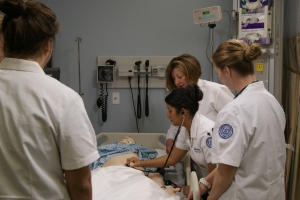
The curriculum fosters the Professional Formation and role transition of the student to the graduate nurse. The Villanova Nurse exemplifies professional values, accountability, social responsibility, advocacy, leadership, collegiality, interprofessional collaboration, scholarly analytical skills, and a service orientation. Professional Formation is the tangible expression of Villanova University’s mission, tradition, and commitment to scholarly inquiry and human service. A Villanova nurse is an intellectually prepared, politically engaged, and globally-centered graduate ready to meet the healthcare needs of individuals, families, and communities locally and globally.
In keeping with Villanova University’s Catholic Augustinian values, “Veritas, Unitas, Caritas” (truth, unity, love), the curriculum fosters lifelong learning, moral reflection, and commitment to service. The curriculum develops and nurtures the whole nurse intellectually, emotionally, spiritually, culturally, and socially in a global environment that respects all individuals and communities. The undergraduate curriculum provides a foundation for graduate study in nursing. Villanova University College of Nursing graduates are a diverse community of scholars, united and dedicated to the highest academic and professional standards.

Foundational Knowledge
Graduates of the Villanova University baccalaureate nursing program are prepared through a curriculum rooted in the liberal arts and sciences that reflects the Augustinian mission and values-based tradition that is the hallmark of a Villanova education. As described in the AACN Essentials of Baccalaureate Education for Professional Nursing Practice (2008), a liberal arts education supports the graduate’s ability to integrate knowledge from the arts and sciences to provide humanistic, quality care. Foundational knowledge is gained from courses selected from among the liberal arts, physical and biological sciences, behavioral and social sciences, philosophy and ethics. These courses expand students’ exposure to other disciplines, facilitate their conversance with the world of ideas, and contribute to their development as liberally educated persons. They strengthen oral and written communication skills, foster respect for human dignity, facilitate the ability to think critically, inform self-development, and encourage an understanding of diversity and global challenges, essential to current and future nursing practice.
Core Nursing Knowledge
Graduates of the Villanova University baccalaureate nursing program are prepared to integrate an extensive core of nursing knowledge into professional practice. Using evidence-based knowledge, which includes genetics, pharmacology, pathophysiology, and nutrition, graduates make informed clinical decisions to assure quality patient outcomes. Graduates respond decisively to changes in the health care environment using knowledge of health care policy, economics, finance and regulatory issues that affect patient care and professional practice. Graduates provide quality care and leadership in health promotion, disease prevention and disease and care management of individuals, families, communities, and populations locally, nationally, and globally. Incorporated in the curriculum are experiences that develop an awareness of and an ability to respond to the global health care environment, including how current trends and issues such as, communicable and non-communicable diseases, health disparities and care of vulnerable populations, and genomics influence the delivery of nursing care. This core nursing knowledge prepares graduates as leaders within the health care system to care for those acute illness and chronic conditions.

Undergraduate Program Outcomes
At the completion of this program, the student will be able to:
1) Value the uniqueness and diversity among individuals through the study of various disciplines and cultures within the context of Catholic Augustinian ideals.
2) Synthesize current, relevant sources of evidence to implement evidence-based nursing practice.
3) Deliver safe, competent, and compassionate, patient-centered care with attention to quality improvement.
4) Use the nursing process to provide patient-centered care based on sound clinical reasoning.
5) Apply information and technology to provide optimal healthcare for individuals, groups, communities, and populations.
6) Provide respectful care that is culturally sensitive and spiritually-based to diverse individuals, groups, communities, and populations with particular attention to meeting the needs of vulnerable populations and those experiencing health disparities.
7) Incorporate a variety of modalities to communicate effectively to achieve quality, patient-centered care.
8) Demonstrate leadership to enhance health care outcomes, influence health policy and advance the nursing profession.
9) Internalize the values and ethics of the nursing profession, which includes advocacy, global awareness, accountability, social responsibility, and collegiality.
10) Demonstrate scholarly, analytical skills to advance the science of nursing.